
Texas Oilfield Accident Lawyer
A lawsuit recovers everything.
Since 2020
Verdict
Settlement
the moment your accident happened.
The Texas oilfield accident lawyer team at Trey Barton Law has successfully represented many oilfield workers and their families, recovering over 60 million dollars on behalf of injured workers in the past five years. With extensive experience and a proven track record in handling oilfield injury claims involving blowouts, equipment malfunctions, and other oil rig accidents, our Texas oilfield injury lawyers have the resources and expertise to ensure responsible parties within the oil and gas industry are held accountable, working tirelessly to secure maximum compensation for our clients.
Our law firm handles oilfield accident cases on a contingency fee basis and offers free consultations, so victims don’t pay anything to secure a favorable settlement offer or verdict.
Call 832-916-2526 or contact our Texas oilfield injury attorneys online to discuss your legal options.
What Are The Steps To Take Following a Texas Oilfield Accident?
Despite what oilfield companies and their insurer say, insurance companies have one goal: to pay substantially less than your oilfield accident case would be worth if you filed a personal injury lawsuit and went to trial. Oil and gas companies will always avoid responsibility.
Additionally, many companies in the oil industry will terminate employment as soon as possible, typically when the statute of limitations expires on personal injury cases.
Many oil companies will require injured oil and gas workers to sign waivers that prevent them from recovering compensation before releasing paychecks. It is crucial that you do not sign anything until you’ve discussed your legal options with an oilfield accident lawyer from our Texas personal injury law firm.
Call 832-916-2526 for a free case review to discuss your legal rights.
How Our Texas Oilfield Accident Attorneys Hold Oil and Gas Companies and Other Responsible Parties Accountable
Confined Space Hazards
To prevent serious and fatal injuries, oil and gas drillers must:
- Ensure adequate training and proper safety and rescue equipment.
- Hold worker safety meetings to establish job details and rescue plans.
- Test the air quality.
- Assign a hole watch.
- Consult the occupational safety coordinator for confined space concerns.
If an oilfield accident occurs due to missed meetings, improper training, or not testing confined space conditions, an oil field injury lawyer from our Texas personal injury law firm can identify safety violations, gather evidence, and pursue oil field claims against the oil companies or other responsible parties to secure the compensation you deserve for crush injuries, or respiratory issues caused by prolonged exposure and inhalation of toxic chemicals, and other expenses for serious injuries.
Control of Hazardous Energy or Energy Isolation Lockout/Tagout (LOTO)
Unexpected energy releases from electricity, fluids, radiation, or machinery can trigger several types of oilfield disasters. Drillers must use lockout/tagout procedures to prevent common oilfield accidents. A Texas oilfield accident lawyer from our law firm can gather internal reports and work tirelessly to prove that lockout/tagout negligence caused the oil field accident. We use this evidence to file oilfield injury lawsuits and secure fair compensation for injured workers.
Hot Work Permits
To prevent flash fires and explosions from hot work near combustible gases, the company man must verify training, secure and post permits, assign fire or line watches, and ensure all safety rules are enforced. When oilfield fires and explosions occur because occupational safety regulations were ignored, a Texas oilfield accident attorney conducts investigations into oil company oversight, preserves inspection records, and provides legal assistance in the oil field injury claims process for resulting harm.
Oil Rig Crane Operations
Only trained personnel should operate cranes or lifts to prevent falling debris and crush injuries. Cranes must be on stable ground with barriers. Operators must assess each lift, choose methods and emergency signals, verify configurations, and ensure cribbing and outriggers are set. A Texas oilfield accident lawyer can investigate whether the oilfield accident was caused by unqualified personnel or other unaddressed dangers. Our legal team uses this evidence to pursue oilfield accident claims against operators or oil companies that violate occupational safety regulations.
Excavation + Trench Collapse
Cave-ins and trench collapses are dangerous hazards in the oil and gas industry. OSHA safety regulations require trained staff, properly designed trenches with marked buried lines, clear escape access, daily inspections, safe material placement at least 2 feet from edges, and for production to immediately stop if collapse risks appear.
Our oil field accident lawyers can examine whether the oil company followed safety regulations. If safety violations led to a trench collapse accident in Texas, we build strong oil field injury cases to recover financial compensation by filing a personal injury lawsuit or wrongful death claim.
Why Oil Well Blowouts / Mud Pump Pressure Events Are More Common During Completion, Intervention, & Workover Than Drilling Rig Blowouts
Well blowouts are catastrophic outcomes in the oil and gas industry. While these common oilfield accidents can occur on drill sites, pressure control loss during completion, intervention, and workovers contributes to 35-40% of blowouts and well control accidents.
- Workover jobs involve repairing or replacing failing or faulty equipment, which increases risks when the integrity of complex machinery is compromised.
- Clear fluids used in completions offer less pressure control than drilling mud.
- Interventions often involve live wells, where surface pressure can cause immediate oil and gas release if well control systems malfunction.
- Preventing blowouts requires fully maintained BOP systems and properly trained crews with proper safety equipment for emergencies.
If an oilfield accident results from missing barriers, faulty blowout preventers, or inadequate training, our Texas oilfield accident attorney team gathers evidence to hold the responsible parties liable and ensures clients don’t accept unfair settlements in Texas well servicing accident claims.
Common Types of Texas Oilfield Accident Cases We Handle
Falling Objects and Oilfield Worker Falls
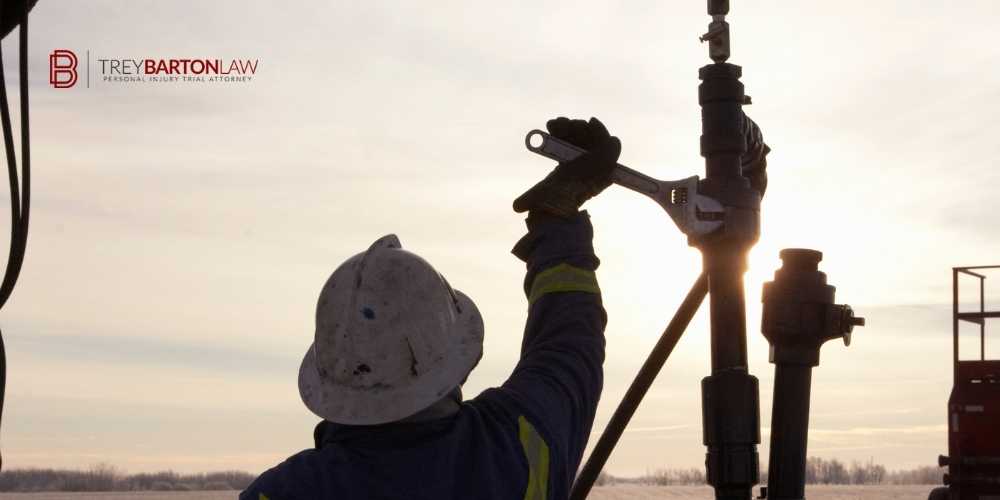
Some of the most common oilfield injuries and fatalities occurring on job sites in the oil industry are caused by falling objects and employees falling from basket trucks, ladders, and rig floors. Unsecured tools, ladders, negligent tie-offs, and a lack of proper safety equipment lead to severe injuries or fatalities. When oil companies or other parties are contributing factors, a Texas oilfield injury lawyer can file a personal injury claim to address the harm caused and recover damages for the injured oil field worker.
Crane Collapse, Heavy Machinery and Equipment Failure
Heavy machinery-related oil field accidents often occur from equipment malfunctions, defective equipment, or improper use of complex machinery like rotary tables, top drives, or mud pumps. Some of the most common injuries in the oil industry result from derrick collapses, catwalk or pipe rack accidents, mud pump explosions, and oilfield workers falling or being struck by unmaintained or defective equipment. Our Texas oilfield injury lawyer team can determine liability and guide clients through the personal injury claims process to recover rightful compensation after heavy equipment accidents in Texas.
Oil Truck Accidents
Vehicle accidents, such as hotshot, vacuum truck, and winch truck rollovers or collisions, are common oilfield accidents that often seriously injure oilfield workers. Oilfield-related truck accidents in Texas may result from fatigue, failing or defective equipment, or impairment. When drunk drivers injure or kill other employees, the drunk drivers face liability, as well as contractors, service companies, or operators for negligence in hiring or management. A Texas oilfield injury lawyer can determine fault and secure fair compensation for victims hurt in oil truck accidents.
Blowouts and Well Control Incidents
Blowout preventer (BOP) failure is dangerous and can cause catastrophic oil field accidents. When a BOP fails to seal the well, this leads to uncontrolled well releases (blowouts), explosions, or fires. These incidents often occur when the equipment malfunctions due to negligent maintenance, installation, or late activation. A Texas BOP failure lawyer can gather evidence, investigate maintenance reports, and pursue liability for preventable well control accidents that cause serious injuries or death.
Oil Field Fires and Explosions
Our Texas oilfield injury lawyers have extensive experience handling oil field injury cases resulting from gas ignition during tank venting or chemical transfers, as well as frac site, mud pump, and pipeline explosion claims in Texas. These oil and gas accidents are dangerous hazards faced by oilfield workers, and often happen when operators violate oil industry safety rules, cutting corners, and putting profits over protecting workers’ safety. Our oil field injury lawyers provide skilled Texas oil field fire claims assistance for workers injured on oilfield sites.
Common Accident Locations
Frac Site Accidents
Frac site accidents often result from valve malfunctions, line ruptures, or sparks near flammable materials, triggering explosions. Fracturing also exposes oilfield workers to toxic chemicals through leaks, spills, or improper use of materials. Hazards increase when machinery is improperly maintained or when contractors bypass oil and gas industry standards. Our Texas oilfield accident lawyer team can gather evidence to prove liability, document chemical exposure and faulty equipment, and hold operators and contractors accountable for financial losses in the aftermath of Texas hydraulic fracturing accidents.
Drilling Site + Rig Operation Accidents
Drilling site and rig operation accidents often include oilfield workers struck by falling materials, tools, or debris, tripping pipe accidents, casing and cementing pressure events, coiled tubing rig accidents, wireline pressure releases, snubbing and swabbing accidents, or structural collapse. These oil field accident cases are often linked to poor management, lack of training, or oil companies putting profits over protecting workers. Our Texas oilfield accident lawyer team conducts investigations, reviews reports, and fights to recover the fair compensation that injured workers deserve for crush injuries, being struck, or pinch point injuries.
Saltwater Disposal Site + Compressor Station Accidents
Saltwater disposal site and compressor station accidents can result from toxic chemical leaks, line bursts, flammable gas ignition, or defective equipment. Oilfield workers face high-pressure line ruptures, valve malfunctions, or exposure to toxic chemicals when job sites are improperly maintained or when OSHA standards are ignored. A Texas oilfield injury lawyer can identify fault and recover compensation for serious and fatal injuries caused by these dangerous conditions.
Refinery Accidents
Refinery accidents often occur when refinery facilities don’t follow essential procedures during processing, unit startups, or shutdowns. Fires, explosions, and toxic gas releases can cause severe burns, respiratory issues, or fatal injuries. When refinery facilities cut corners on maintenance, a Texas oilfield accident attorney from our legal team can investigate and recover compensation for serious and fatal injuries.
Common Oil Rig Accident Cases We Handle
Our oilfield accident lawyers in Texas provide legal assistance for the following oil rig accidents in the Lone Star State, and more:
Oil Rig Explosions + Fire Hazards
Oil rig explosions can result from a topside gas leak, faulty ignition controls, or pressure buildup on offshore units such as FPSOs. These common oilfield accidents cause serious and fatal injuries and often occur from oil companies’ negligence. A Texas oil rig explosion lawyer can investigate the circumstances, calculate wrongful death or personal injury damages, and determine the best course to help victims and their families secure maximum compensation.
Oil Rig Structural Failures + Platform Collapse
Derrick collapse, catwalk and pipe rack collapse, and structural failure of top drives or rotary tables can cause serious and fatal injuries, especially on offshore units like jack-up rigs and semi-submersibles. Our Texas MODU accident lawyer team conducts thorough investigations, identifies at-fault parties, and files oilfield injury claims to recover compensation for oilfield accident victims and their families.
Subsea Accidents, Diving Accidents, & Confined Space Tank Entry Accidents
Subsea and diving oil rig accidents can occur during underwater welding, diving bell use, or retrieval tasks. Dangerous hazards such as pressure shifts, poor visibility, and limited access to support put oil and gas divers at significant risk of fatality. An oilfield injury lawyer in Texas can review dive records, assess compliance, and secure maximum settlements for oilfield workers or their loved ones.
Top Drive Accident + Rotary Table Accident
Top drive and rotary table accidents are common types of drilling operation accidents. They can cause dropped drill strings, sudden rotation, and employees to be killed from being crushed. When contractors don’t maintain this, our oilfield accident attorneys in Texas file oil field injury claims to help oil and gas workers recover their rightful compensation.
Tripping Pipe Accident + Derrickhand Injury
Tripping pipe accidents and derrickhand injuries often occur from rapid drill string movement, slip failure, or pipe handling malfunctions. Derrickhands on monkey boards face serious fall risks, crush injuries, and being struck. Our oilfield accident lawyers in Texas can work to ensure liable parties are held accountable and pursue the compensation you deserve.
Catwalk, Pipe Rack, & Manlift Accidents
Catwalk, pipe rack, and man lift accidents often result from failing or defective equipment, poor visibility, or OSHA violations. Oilfield workers may suffer crush injuries or fall from manlifts. Our Texas oil field injury lawyers can examine the circumstances, determine the severity, and recover fair compensation for preventable on-the-job injuries.
Marine Transfer & Manlift/Basket Transfer Incidents
Marine transfer accidents happen when oilfield workers are moved using manlift or basket transfers, gangways, or ladder transfers. Rough seas, miscommunication, or misalignment can lead to severe injuries and fatalities. A Texas oilfield accident lawyer can identify negligence, OSHA violations, and represent injured employees in maritime accident claims.
Common Injuries Suffered in Texas Oil Field Accident Cases
When oilfield accidents occur, employees face life-altering injuries, medical bills that their families are unable to pay, and an uncertain future. Some of the most common injuries suffered in the oil field include:
These common oil field injuries happen when bodies or limbs are pinned down, often leading to broken bones, compartment syndrome, or amputations, requiring immediate medical attention and a skilled oil and gas crush injury lawyer in Texas to ensure legal rights are upheld.
Burns in oilfield accidents require immediate medical treatment, surgeries, and skin grafts to minimize scarring. Our oil field accident lawyers can help oilfield workers access far better medical care than what’s provided by workers’ compensation doctors, connecting clients with top burn specialists and ensuring the full value of medical treatment and future medical expenses are covered in the oil field injury claim.
Our Texas oilfield accident attorneys help traumatic brain injury and head injury victims seek medical attention from top neurologists, far better than workers’ compensation claim doctors. We secure medical records and expert testimony to prove the severity of the health impact and seek fair compensation for mounting medical bills, future medical expenses, and future health outcomes.
Our oil field injury lawyers in Texas help clients suffering inhalation injuries from exposure to toxic chemicals access respiratory specialists, toxicologists, and quality medical care that workers’ compensation doctors don’t provide. We seek the compensation you deserve for immediate medical treatment and future financial losses for medical bills, lost wages, and long-term health effects associated with toxic exposure injuries in Texas.
Our oil field accident lawyers help clients with spinal cord injuries caused by falls, defective equipment, repetitive motions, heavy lifting, or other hazards. We access spine specialists and medical care that workers’ compensation claims don’t cover. We seek fair compensation for immediate medical attention costs, lost income, medical expenses in the future, and other financial losses.
Our oil field injury lawyers help oilfield workers suffering eye injuries get treated by vision specialists. This isn’t covered by workers’ compensation claims. We seek the compensation you deserve for mounting medical bills immediately and in the future, and full recovery for lost earning capacity.
Our oilfield accident attorneys help electrocution victims access proper medical care not covered in workers’ compensation claims. We seek financial compensation for immediate and future health effects of electrocution-related trauma.
Maximum Compensation For Oilfield Accident Victims in Texas
Oil and Gas Workers' Compensation Benefits
Oil and gas workers’ compensation insurance companies cover medical expenses when injured employees seek medical attention for workplace accidents and a portion of lost wages. Workers’ compensation claims don’t cover non-economic damages, like pain and suffering, full disability, or future care. Since employers pay workers’ compensation doctors, they’re pressured to report oil field injuries as less critical than they are.
Injured workers should file a personal injury lawsuit whenever possible to recover the full value of economic and non-economic damages and access to better medical care.
How To File an Oilfield Accident Claim in Texas
Oilfield workers suffering on-the-job injuries cannot sue employers if the employer carries workers’ compensation insurance. However, when employers don’t provide workers’ comp benefits or when third parties such as contractors, manufacturers, or outside parties contribute to workplace accidents, oilfield workers can file a personal injury lawsuit.
Workers’ compensation claims only provide limited workers’ compensation benefits:
- 70% of pre-accident income for temporary benefits if earnings are above $1,111/week
- A maximum cap of $1,172 per week for temporary income benefits
- No non-economic damages or future expenses
Compare this to high-earning oilfield workers earning $100,000-$160,000/year. With workers’ compensation claims, they’d lose over $95,000/year in unpaid income alone, not including future income and non-economic damages.
In contrast, filing a personal injury lawsuit can help recover damages for immediate costs and expenses moving forward. Personal injury damages include the full amount of economic damages like lost income and earning capacity, mental anguish, disfigurement, rehabilitation, pain and suffering, and other expenses related to the oil field accident, including court costs.
Additionally, our oil field injury lawyers seek punitive damages when defendants are grossly negligent. Punitive damages are capped at $200,000 or 2x the economic and non-economic damages, not exceeding $750,000.
Employers always pressure workplace accident victims not to contact personal injury lawyers. Company men and insurance companies claim they’ll “take care of everything”. This is not for your protection; it’s to avoid responsibility.
Jones Act Claims for Offshore Workers
Offshore oilfield workers injured on drilling rigs, MODUs, or marine vessels may qualify as seamen. Our Texas offshore injury lawyers file Jones Act claims to hold employers accountable for negligence, vessel hazards, and unseaworthiness. Texas Jones Act claims assistance allows clients to pursue full compensation for lost wages, medical costs, pain and suffering, and long-term disability beyond what workers’ comp provides.
Texas Oilfield Death Cases
Our Texas oil field accident lawyers can file a wrongful death claim for fatalities occurring because of someone else’s negligence. Even if employers carry workers’ compensation insurance, surviving family members can still sue employers for gross negligence or wilful misconduct (common in the oil and gas industry). Families can also file wrongful death lawsuits against third parties, like contractors, manufacturers, and service companies.
Texas doesn’t cap punitive damages in wrongful death claims, and our oilfield accident lawyers pursue punitive damages when wrongful death results from gross negligence, fraud, and malice.
Settlements and awards for Texas oilfield death claims can cover:
- Loss of earning capacity/support
- Loss of companionship/society
- Mental anguish
- Loss of inheritance
Workers’ compensation claims don’t cover any of those.
If surviving family members (spouses, children, or parents) don’t sue for the death of their loved one within 3 months, the estate’s executor or administrator may file.
The statute of limitations is two years from the date of death.
Pain & suffering, future earnings, and full medical care are not covered by workers' comp.
Major Texas Shale Formations and Risks in the Oil and Gas Industry
Austin Chalk
The Austin Chalk formation presents numerous production hazards and unstable geology. Our oilfield accident lawyers handle Austin Chalk accident claims for oilfield workers seeking full compensation.
Eagle Ford Shale
The Eagle Ford Shale presents unique hazards from intense drilling activity, dense traffic, and high-volume fracturing. Our law firm handles Eagle Ford accident claims for preventable on-the-job injuries.
Haynesville Shale
The Haynesville Shale is known for specific dangers that often cause catastrophic but common oilfield injuries. Our oilfield accident law firm handles Haynesville Shale accident claims for affected oilfield workers.
Locations Our Texas Oilfield Injury Attorney Team Serves
Our Texas oil field accident lawyers have specific expertise in the following areas:
- Atascosa County oilfield injury
- Bee County oilfield injury
- Bexar County oilfield injury claim
- Brazos County oilfield injury
- Burleson County oilfield injury
- Comal CO oilfield injury claim
- DeWitt CO oilfield injury claim
- Dimmit CO oilfield injury claim
- Ector County oilfield injury
- Fayette CO oilfield injury claim
- Frio CO oilfield injury claim
- Gonzales CO oilfield injury claim
- Gregg County oilfield injury
- Guadalupe CO oilfield injury claim
- Houston oilfield injury claims throughout Harris County
- Karnes CO oilfield injury claim
- La Salle CO oilfield injury claim
- Lavaca CO oilfield injury claim
- Lee County oilfield injury
- Live Oak County oilfield injury
- McMullen County oilfield injury
- Panola County oilfield injury
- Victoria CO oilfield injury claim
- Webb County oilfield injury
- Wilson CO oilfield injury claim
- Zavala County oilfield injury
Contact an Oilfield Injury Lawyer Texas Families Trust For a Free Consultation
If you were seriously injured in an oilfield accident or lost a loved one, our legal team handles oilfield injury lawsuits and wrongful death lawsuits on a contingency fee basis. Call 832-916-2526 for a free consultation with our Texas oil field accident lawyers.
Oil and Gas Locations
Serving These Cities & Counties in Texas
Free Consultation
Our experienced Houston personal injury attorneys want to get to know you and understand your unique situation. We offer a free, no-obligation consultation. You don’t pay unless your case is won.
Awards & Recognition






No Fee Unless You Win
Trey Barton understands the hardships injured people and their loved ones face as they try to heal from their accident. Every case is prepared as if it is going to trial. This gives you the best opportunity to obtain a fair recovery for your case, and ensures I am positioned to take the case to trial if the insurance company does not give you the money you deserve.