
Texas Well Casing Failure & Cement Failure Lawyer
A Texas well casing failure & cement failure lawyer represents workers injured when a casing string parts, collapses, or a primary cement job loses zonal isolation. When these failures occur, they cause blowouts, annular gas migration, fires, and fatal well control events. Trey Barton Law, a Texas oilfield accident law firm, pursues operators, cementers, and casing crews statewide.
Hablamos español.
Statewide Reach. No Fee Unless We Win.
What Well Casing Failure & Cement Failure Mean Downhole
Barrier envelopes hold wells together, not a single pipe. Conductor, surface, intermediate, and production casing strings are run in decreasing diameters. Each string of steel casing is cemented into the annulus between the pipe and the borehole wall.
The primary cement sheath supports the casing mechanically and seals the cement-to-formation interface, so gas, oil, and fracturing fluids can’t travel up the annulus. That sealing ability is zonal isolation. This is the barrier petroleum engineers and regulators watch most closely. It’s the foundation of wellbore integrity in both oil wells and gas wells.
A well integrity failure means one or more barriers are gone. One lost barrier doesn’t always reach the surface. It can still escalate to an underground blowout, annular gas at the wellhead, or a surface release that puts crews in the path of ignition, often alongside oilfield equipment failures at the rig floor.
- 1Conductor casing — first string set, supports the hole near surface and isolates shallow ground.
- 2Surface casing — protects usable-quality water and anchors the wellhead and BOP stack.
- 3Intermediate casing — isolates unstable or over-pressured intervals between surface and pay.
- 4Production casing — carries stimulation and production pressure across the reservoir.
- 5Cement sheath — fills each annulus, supports the casing, and seals the cement-to-formation interface. Lose it and gas migrates up the annulus.
Fracking Well Casing Failure Rates & Well Casing Failure Data
If you were hurt or lost someone in a cementing or well casing failure, the company will likely call it a “freak accident.”
It wasn’t.
Cement and well casing failures are well-known within the industry and preventable, particularly on fracked wells.
A peer-reviewed study of more than 41,000 wells found casing or cement problems in 6.2% of fracked shale gas wells, about 6x the rate of conventional wells.
Offshore, regulators have found sustained casing pressure in over 11,000 casing strings in the Gulf of Mexico. That pressure indicates a prior well barrier failure occurred. Workers pay the price.
Bureau of Labor Statistics data reported 65 oil and gas extraction deaths nationwide in 2024, with many happening in rural areas.
This matters for cementing and well casing failure cases because the risk is foreseeable.
Operators and cementing companies have the numerical simulation, experimental results, and field data showing how cement sheath failure occurs under multistage hydraulic fracturing. Pumping a fracking job into a well they know is weak is negligence, not bad luck.
We handle Texas fracking accident cases built on exactly this evidence.
Why Texas Casing & Cement Jobs Fail
Casing and cementing failures typically trace back to decisions about slurry design, centralizer placement, waiting-on-cement time, pipe design, or injection rates. Each ties to a responsible company on the wellsite.
How Loss of Cement Sheath Integrity Causes Rig Explosions
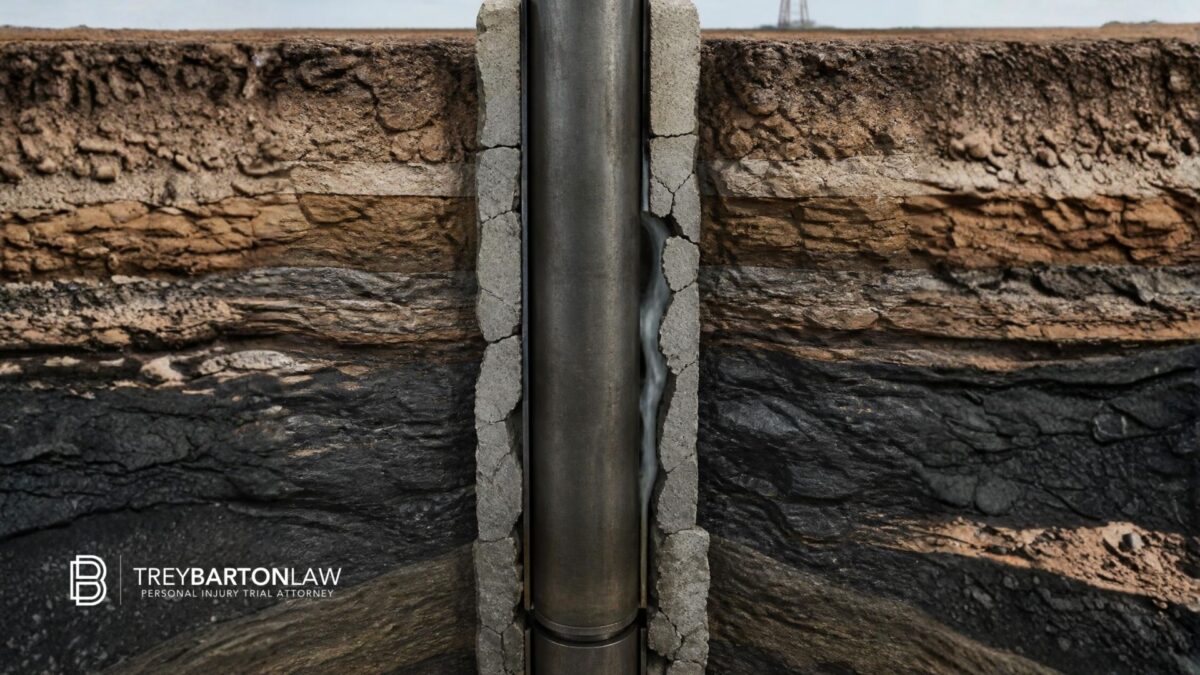
Cement sheath integrity stands between a pressurized reservoir and the rig floor. The most common cause of lost sealing integrity is inadequate mud displacement. Drilling fluid that the slurry never displaced leaves a continuous channel along one side of the hole. Gas flow travels up that channel toward the surface.
Gas migration while the slurry sets is equally dangerous. As cement develops static gel strength, it loses hydrostatic pressure. When formation pressure exceeds the falling column pressure, gas percolates into the setting cement and creates permanent gas flow paths.
Once the gas reaches the wellhead or shale shakers and finds ignition, this becomes an oil or gas fire accident. These events produce burns rather than ‘near misses.’
Many overlap with Texas BOP failure and well control claims when the last barrier also fails to close.
Understanding Cement Sheath Failure Mechanisms & Operator Negligence
Set cement is brittle, with limited tensile strength. The lab measures its mechanical properties (Young’s modulus, internal friction angle, and compressive strength) before any job is pumped.
Petroleum engineers feed those mechanical parameters into a finite element model or similar numerical model. Boundary conditions are set by the well’s geometric parameters. The model predicts the sheath’s mechanical behavior under internal pressure acting on the casing, temperature variation, and confining pressure from the formation.
The failure criteria are well established:
- Burst loading: too much stress from casing internal pressure puts the sheath into hoop tension, producing radial cracks and tensile failure.
- Pressure release and cooling: the casing pulls back, opening a micro annulus where shear stresses strip the bond.
- Cyclic loading: multistage hydraulic fracturing, closely spaced stages, and frac hits accumulate damage over the life of the well. This is why long term well integrity in horizontal shale wells degrades in ways vertical wells rarely do.
Negligence happens when operators ignore numerical estimates.
Slurry systems with lower Young’s modulus, latex additives, fluid loss control, and expanding formulations exist for high pressure and dynamic loading. These all significantly reduce the risk of cement sheath failure.
Constant budgeting issues don’t excuse choosing a brittle, minimum-cost slurry. Operators must prioritize safety over protecting the project’s net present value.
The same pattern appears in workover rig accidents across Texas when wells are re-entered after original jobs fail.
Dangerous Casing Deformation & Structural Wall Failures
Casing deformation is the structural half of the problem.
In horizontal wells, production casing is subjected to axial tension and compression, bending through the curve between the vertical section and the horizontal section, and external collapse loading from formation pressure or salt creep. The production casing also takes internal pressure during stimulation. When the stress state exceeds the steel’s yield strength, the steel casing moves into plastic deformation and the inner diameter is permanently reduced.
Operators typically detect production casing deformation when tools won’t pass, plugs won’t set, or a caliper run shows a restriction. By then, strings have already lost design margin. Collapse, coupling failures, and parted strings follow from the same overload. This can unload the well in seconds.
Fault movement, asymmetric fracturing, and closely spaced clusters concentrate load along the lateral, where casing damage is repeatedly reported in tight oil fields and shale gas wells.
Ignoring Safety Limits: Casing Wall Thickness & Failure Criteria
Casing wall thickness is the most direct control on how much internal pressure a string can withstand. Pipe design sets wall thickness, grade, and diameter against calculated burst, collapse, and tension loads, with a safety factor applied. Those calculations assume the pipe arrives at nominal thickness and stays there. But it often doesn’t.
Corrosion, H2S embrittlement, proppant erosion, manufacturing defects, and wear from drillstring rotation all lead to a reduction in the casing wall’s thickness. When a string is run without accounting for that, or a lighter grade is substituted to cut total well cost, the real failure criteria sit far below the calculation.
Sustained casing internal pressure, pressure test failures, and MIT results expose this. This evidence is in the operator’s reports. Many victims need a cementing and well casing failure lawyer in Texas to compel the proof of negligence.
Injuries From On-Site Casing Falls & Dropped Pipe Accidents
Not all well casing failures happen downhole. Dropped pipe, swinging joints, failed elevator latches, and pipe rolling off the rack cause crush injuries, amputations, and deaths. The risk multiplies when strings are re-run after a failed cement job.
The work is unplanned, the crew is fatigued, and schedule pressure peaks. Our well casing and cementing failure attorneys often handle cases involving rushed rig-up, inadequate JSAs, and workers positioned in the drop zone.
Failure Mode | Downhole or Surface Indicator | Common Cause | Common Defendants |
|---|---|---|---|
Cement channeling | Poor bond on cement bond log, gas at casing vent | Inadequate mud displacement, no pipe movement during the job | Cementing service company & operator |
Insufficient centralization | Eccentric casing on USIT or CBL, one-sided cement | Centralizer placement plan not followed in deviated or horizontal hole | Casing running crew & operator engineering |
Gas migration during transition | Sustained casing pressure, annular flow at surface | Slurry design with poor static gel strength or fluid loss control | Cementing service company |
Premature drill-out | Failed shoe test, cement returned to surface after drill-out | Drilling out before compressive strength develops | Drilling contractor & operator |
Lost circulation | No returns, top of cement below planned depth | Weak formation, mud program not adjusted for the hole | Operator & mud/ fluids provider |
Casing collapse or deformation | Restricted inner diameter, tools will not pass, stuck plugs | Formation loading, salt creep, string under-rated in pipe design | Operator pipe design & casing manufacturer |
Connection and thread failure | String parts, sudden pressure loss | Improper make-up torque, wrong grade or coupling selection | Casing crew & connection manufacturer |
Corrosion and H2S embrittlement | Wall thickness loss on caliper logs, pitting, cracks | Wrong material selection for sour service conditions | Operator & manufacturer |
Cyclic stress from fracturing | Micro annulus, casing deformation at closely spaced clusters | Multistage hydraulic fracturing loads, frac hits, temperature variation | Operator & fracturing service company |
Unremediated sustained casing pressure | Pressure rebuilds after every bleed-down | Decision to bleed and re-bleed instead of repairing the barrier | Operator |
Sustained casing pressure is important because it’s the signature of a failed barrier. Pressure that rebuilds after the annulus is bled to completion means gas is moving where it’s supposed to be sealed.
A federal review documents this phenomenon in detail.
Operators may bleed and re-bleed wells for months instead of running a remedial squeeze. Here, every recorded reading becomes evidence showing the company knew the well had lost integrity and continued oil and gas production, despite the increasing risks.
Injuries Caused by Casing & Cement Failures in Texas Oilfields
The injuries from a casing breach or failed cement sheath come from stored energy released all at once.
Burn & Blast Injuries from Casing Failure Blowouts
When annular gas reaches the surface, it accumulates around the wellhead, rig floor, or shale shakers, finds an ignition source, and flashes. Burn victims are often treated at UTMB Blocker Burn Unit in Galveston or Memorial Hermann in Houston, but survival often turns on how fast a worker gets there. We handle both land-based cases and oil rig explosions in the Gulf of Mexico arising from exactly this sequence.
Brain Injuries in Well Control Events
A parted casing string or unloading wellhead produces a pressure wave and turns nearby equipment into projectiles. Head trauma and brain injuries are often missed at the scene because burns and fractures dominate triage.
Deficits and changes often surface weeks later. Our Texas casing and cementing failure attorneys build cases around documenting delayed presentation for traumatic brain injury representation.
Amputations & Workers Crushed During Casing Running Operations
Casing running operations put limbs and bodies in the line of fire. The risk peaks on unplanned re-runs after a failed job, so we pursue oilfield crush injury lawsuits against the contractors who controlled the operation and its sequence.
Toxic Exposure from Failed Zonal Isolation at Wells
Loss of zonal isolation can vent hydrogen sulfide and hydrocarbon gas through a compromised annulus. H2S deadens the sense of smell at exactly the concentrations that become dangerous.
Texas requires monitoring and training in designated H2S operations. This means toxic exposure claims in Texas often come with a compliance record attached to failed barriers.
Who Can Be Held Responsible for a Cementing or Casing Failure in Texas
One site can have an operator, drilling contractor, cementing company, casing crew, wireline provider, mud company, and independent consultant, all under separate contracts. Besides the injured worker’s employer, potentially responsible parties can include the following:
- Operator: approves the drilling and completion program, sets injection rates and pressures, and decides whether to remediate a known barrier failure
- Drilling contractor: responsible for rig operations, waiting-on-cement time, and drill-out decisions
- Cementing service company: responsible for slurry design, lab testing, pumping the job, and evaluating the result
- Casing running crew: responsible for handling, make-up torque, centralizer placement, and running procedure
- Mud and fluids provider: responsible for the fluid program and displacement conditioning before cement
- Casing and connection manufacturer: where a defect, wrong grade, or unsuitable sour-service material contributed
- Wireline or cement bond log evaluator: where a bad job was logged as acceptable
- Wellsite consultant or company man: whose calls on the program can create direct liability
Employees can’t sue subscribing employers. However, injured workers can file lawsuits against all other parties who caused or contributed to a cementing failure or well casing failure. That’s where meaningful compensation comes in. It’s the core of our work as Houston oilfield injury lawyers in related industrial accident claims.
Legal Options a Texas Well Casing Failure & Cement Failure Lawyer Can Help You Pursue
Your legal options depend on whether your employer subscribes to workers’ compensation, where the well sits, and whether the employee survived.
Non-Subscriber Claims Against Employers
Texas allows private employers to opt out of workers’ compensation. Non-subscribers lose key defenses, such as contributory negligence, assumption of risk, and the fellow servant rule. Only 24% of Texas employers were non-subscribers in 2024, the lowest level in a decade. However, non-subscribers are fairly common in oil and gas production work.
Confirming your employer’s status is the first step in any Texas personal injury representation we take on.
Third-Party Negligence Claims Against Cementers & Casing Contractors
If your employer subscribes to workers’ compensation, you can’t sue them for negligence. However, this does nothing to keep you from suing the cementing company, casing crew, operator, or manufacturer. Most recovery in casing failure cases comes through third-party claims because the companies that designed the slurry, pumped the job, ran the string, or ignored sustained casing pressure readings rarely employ the injured worker.
Jones Act & Maritime Claims for Offshore Cementing Failures
Offshore cementing failures fall under maritime law. A worker with a substantial connection to a vessel in navigation qualifies as a seaman and can bring three claims:
- A Jones Act negligence claim under a featherweight causation standard
- An unseaworthiness claim against the vessel owner
- A claim for maintenance and cure owed regardless of fault
A mobile offshore drilling unit is generally a vessel and a fixed platform generally is not, and that distinction changes the entire case. Our Texas cementing failure and well casing failure lawyers handle both fixed platform and MODU accident claims.
Wrongful Death & Survival Claims After a Fatal Well Control Event
The Texas Wrongful Death Act lets the surviving spouse, children, and parents recover for their own losses. A separate survival action belongs to the estate and covers what the worker suffered before death.
Even where the employer is a workers’ compensation subscriber, a surviving spouse or heir can sue for punitive damages if gross negligence is proven. Our well casing failure attorneys handle both oilfield wrongful death claims in Texas and offshore rig death cases in the Gulf of Mexico.
Your window is closing. Evidence disappears faster than the deadline does.
Call 832-916-2526 Today Request a free case reviewTexas filing deadlines by claim type
This is a general estimate and isn't legal advice, and no attorney-client relationship is created by using this tool.
Evidence That Wins a Cementing or Casing Failure Case
Evidence in a casing or cement failure case has a short life. A cement squeeze destroys the physical record of the job, daily reports are overwritten, and pressure data rolls off. Pulled pipe is cleaned and returned to service. Operators control almost all evidence. Companies begin internal investigations immediately.
Evidence that decides cementing and casing failure cases includes:
- Cement bond logs, variable density logs, and ultrasonic imaging tool runs
- Cement job tickets, slurry design, and lab data including thickening time and compressive strength development
- Daily drilling reports and IADC reports for the relevant tour
- Casing tally, running procedure, centralizer placement plan, and torque-and-drag records
- Mud logs, pit volume totalizer records, and returns data
- Pressure test records, MIT results, and annular pressure logs
- BOP function and pressure test certifications
- Third-party wellsite consultant reports and morning reports
- RRC filings including Form W-2, Form G-1, and any Statewide Rule 13 exception applications
- OSHA 300 logs, JSAs, safety meeting records, and the operator’s incident investigation file
All wells are built under the Railroad Commission’s casing and cementing requirements. This sets standards for casing setting depth, cement volume, and waiting-on-cement time.
Our well casing failure attorneys sent spoliation letters to preserve this material. These letters put all companies on written notice to preserve records, physical components, and the well itself. This is ideally sent before the squeeze job.
Evidence disappears within days. Call before the well is remediated.
Get a Free Case ReviewCompensation in Cementing and Casing Failure Claims in Texas
In cementing and casing failure claims, compensation is determined by injury severity and how well losses are documented. Life-care planning runs for decades.
A rotational oilfield wage with per diem is also worth far more than a standard wage calculation. Damages typically include:
- Past and future medical expenses
- Lost wages and lost earning capacity, including loss of a rotational schedule and per diem
- Pain and suffering
- Scarring and disfigurement
- Home modification, prosthetics, and life-care plan costs
- Loss of consortium and loss of household services
- Exemplary or punitive damages where gross negligence is established
- Wrongful death pecuniary loss, loss of companionship, and mental anguish for beneficiaries
Trey Barton Law has recovered more than $60 million for injured clients since 2020, including a $6.95 million wrongful death verdict and a $1.8 million oilfield injury settlement. Work starts with a free case evaluation.
in Settlements & Verdicts Since 2020
Over $70 Million in Settlements and Verdicts Since 2020
Texas Well Casing Failure & Cement Failure Lawyer Serving Every Major Play
Trey Barton Law is a personal injury law firm in Sugar Land that focuses primarily on oil and gas production accidents. His Houston personal injury law office is available by appointment.
The firm is licensed in all Texas state, district, and county courts and in the U.S. District Court for the Southern District of Texas. That means a case can be filed where the defendant is, not only where the well is. Contact our law office for a free case analysis.
Fort Bend County & the Greater Houston Metro
Fort Bend County district courts in Richmond hold venue for locally based defendants, while Harris County civil district courts handle Houston-based operators and service companies. Our cementing and well-casing failure lawyers handle personal injury cases in Richmond and Rosenberg, TX, along with Houston Ship Channel accident claims.
Eagle Ford Shale Casing and Cement Failures: Karnes, DeWitt, La Salle, Dimmit, Frio, Gonzales, & Wilson Counties
Eagle Ford has the highest density of horizontal shale wells and completion activity in South Texas, with district courts in Karnes City, Cuero, Cotulla, and Carrizo Springs. The formation also carries the delayed emergency response documented in NIOSH FOG reporting. Our well casing and cement failure attorneys handle oil and gas production accidents throughout the Eagle Ford Shale formation.
San Antonio, Bexar, Comal, Guadalupe, Victoria, & Lavaca Counties
This corridor feeds the Eagle Ford with service companies, sand logistics, and cementing operations, which is why the Bexar County Courthouse in San Antonio is often the right venue for a service-company defendant headquartered there rather than the rural county where the well sits.
Permian Basin, Austin Chalk, & Haynesville Shale Casing Failures
Midland-Odessa deep horizontal work carries the highest fatality concentration nationwide. The court. is typically within Midland County district courts. Austin Chalk redevelopment across Fayette, Lee, and Bastrop Counties and Haynesville deep gas completions in East Texas add high-pressure, high-temperature conditions where cement sheath failure is more likely.
Why Injured Workers Choose Trey Barton Law
Our cementing and well casing failure lawyers prepare all cases for trial. This is the only position that helps negotiate fair settlements. Defense counsel for operators and cementing companies can tell a case built to settle from a case built for a jury. They pay accordingly. A Texas well casing failure and cement failure lawyer who has never tried one is negotiating without leverage. The reputation behind our posture is public: over $60 million recovered since 2020, including a $6.95 million wrongful death verdict. We work on a contingency fee basis and offer free case evaluations, so there’s no fee unless we win. Representation is on contingency, with a free consultation and no fee unless we win. Meet our oilfield injury trial team or schedule a free consultation today. Hablamos español.Texas Well Casing & Cement Failure FAQs
To learn more about pipeline explosion claims or other personal injury FAQs, contact our attorneys for a free consultation.Do I have a case if my employer says the cement job was done by another company?
Yes, you may have a case if your employer said the cement job was performed by another company. Outside contractors don’t have workers’ compensation immunity. The laws that protect your employer from lawsuits don’t protect third-party companies. When cementing or well-casing failures occur, the operator, cementing service company, casing crew, mud provider, and casing manufacturer can all be responsible parties.
How long do I have to file a Texas casing failure claim?
Generally, you have two years to file a casing failure claim in Texas. However, there are a few exceptions.
- Personal injury and non-subscriber claims: two years from the date of injury
- Wrongful death and survival claims: two years from the date of death
- Claims against a government entity: formal written notice in as little as six months, and shorter under some city charters
- Jones Act and general maritime claims: three years from the date of injury
What is sustained casing pressure and why does it matter to my case?
Sustained casing pressure is pressure inside the well’s casing annulus that rebuilds after it’s been released. It means gas is flowing through a barrier that was supposed to be sealed. The pressure is measured and reported in the operator’s records. It proves:
- a well barrier was already failing before the accident
- the operator knew, because the pressure readings should appear in the company’s records
- the operator continued production instead of fixing the problem, such as running a remedial squeeze. This can support a gross negligence case.
Can I sue if I already accepted workers' compensation benefits?
Yes, you can sue outside parties even if you’re receiving workers’ compensation benefits.
- You can still sue a negligent operator, cementer, casing crew, and/or manufacturer
- The workers’ compensation carrier will assert a subrogation interest in any third-party recovery, which is negotiable
- Benefits keep medical care flowing while the third-party case is built
What does a Texas well casing failure & cement failure lawyer cost?
It doesn’t cost anything upfront to hire a Texas well casing failure or cement failure lawyer. We offer free consultations and handle claims on a contingency fee basis. This means our firm advances the costs for engineering experts, log analysis, and depositions. Call 832-916-2526.
Practice Areas
Serving These Cities & Counties in Texas
Free Consultation
Our experienced Houston personal injury attorneys want to get to know you and understand your unique situation. We offer a free, no-obligation consultation. You don’t pay unless your case is won.
Awards & Recognition






No Fee Unless You Win
Trey Barton understands the hardships injured people and their loved ones face as they try to heal from their accident. Every case is prepared as if it is going to trial. This gives you the best opportunity to obtain a fair recovery for your case, and ensures I am positioned to take the case to trial if the insurance company does not give you the money you deserve.